About this document
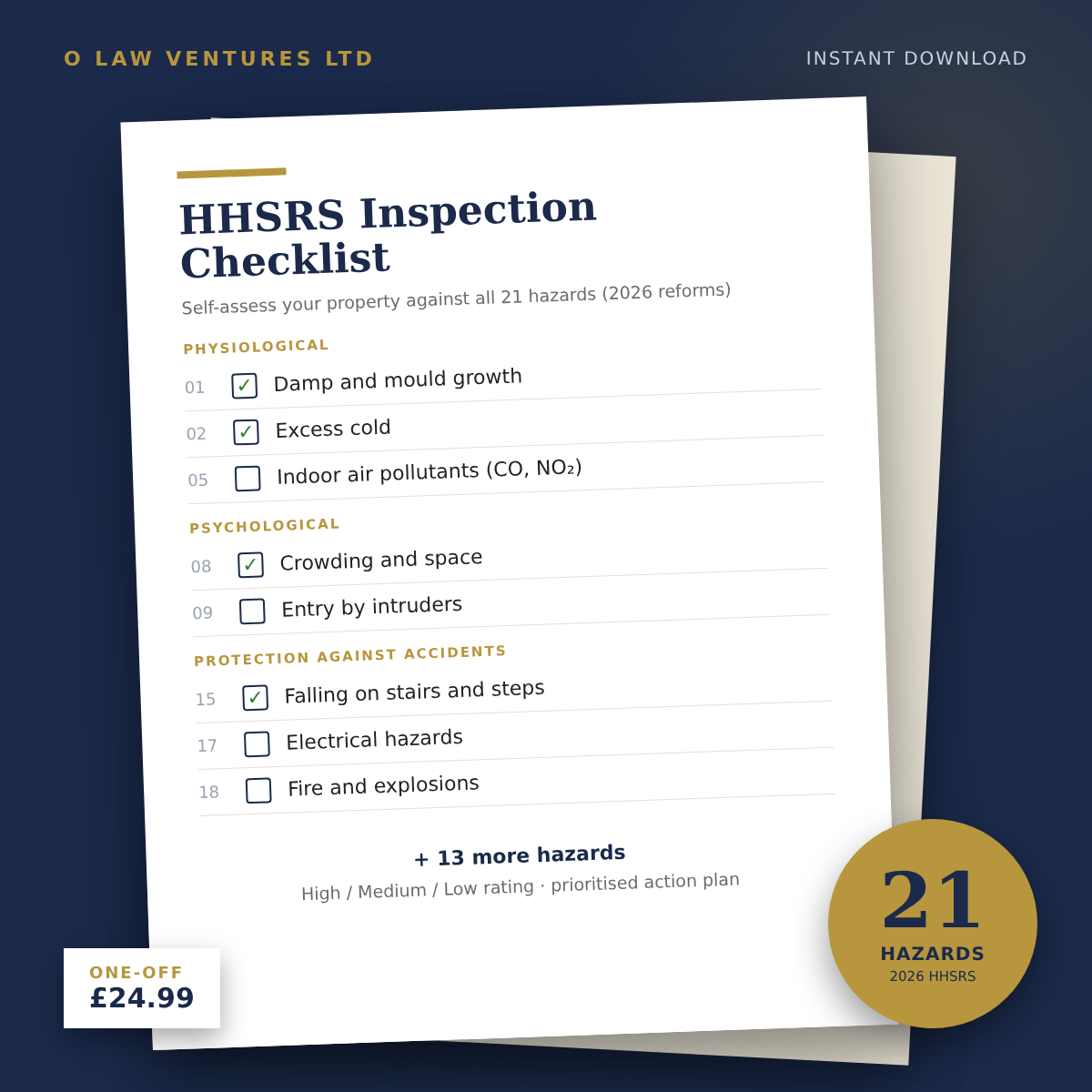
A practical landlord/agent checklist covering the 21 HHSRS hazard categories to help you self-assess a property before a professional inspection.
Secure payment by Stripe. This is a template document, not legal advice.
What you get
- Instant download immediately after secure Stripe payment
- Fully updated for the Renters' Rights Act 2025 and Housing Act 2004
- Prepared by a qualified HHSRS practitioner with 25+ years' experience
- One-off payment — no subscription, no hidden fees
Prefer it done for you? Get professional HHSRS reports or read the HHSRS Guide.
Prefer a document tailored to your property? Explore our compliance services or read our HHSRS hazards guide.
Pay once, download instantly.
About the HHSRS Landlord Checklist
The HHSRS Landlord Checklist is a practical, room-by-room self-assessment tool covering all 21 hazard categories in the revised Housing Health & Safety Rating System (2026). It walks you through each of the four hazard groups so nothing is missed:
- Physiological — damp and mould, excess cold and heat, asbestos, indoor air pollutants, lead and radiation.
- Psychological — crowding and space, entry by intruders, lighting and noise.
- Protection against infection — domestic hygiene, pests and refuse, and water supply.
- Protection against accidents — falls on the level, on stairs and between levels, electrical hazards, fire and explosions, hot surfaces, collisions and entrapment, and structural collapse.
For each hazard the checklist prompts you to record the condition, note any defects and flag the likely risk band, so you can prioritise remedial works before a tenant complaint or a local authority inspection.
Who it's for: private landlords carrying out pre-tenancy or periodic checks, letting and managing agents standardising their inspections, and HMO operators who need a consistent record across a portfolio. It's written in plain English, needs no specialist training and can be completed on a single visit.
How it differs from a professional inspection: this checklist helps you self-assess and spot obvious issues early. It is not a substitute for a formal, court-ready HHSRS hazard report. Where a property is complex, a hazard is borderline, or you need defensible evidence for a tribunal, enforcement response or possession claim, a qualified practitioner should carry out the assessment.
New to HHSRS? Read our full guide to the 21 hazards to understand what each category covers and how the 2026 banding works.